Showing posts with label Vocabulary. Show all posts

Friday, April 5, 2013

Quadrilaterals

So I thought over spring break I would catch up on all of my blogging, find cool new activities to do with my math students, and create some new ISN pages.  Well needless to say that never happened...

We covered Quadrilaterals in Geometry class, however we only went with regular quadrilaterals for the time being.

My students love charts, and when I say love I really mean LOVE!!  It's weird how excited they can get about a chart, but whatever will make them happy.  So to cover the characteristics of the different types of regular quadrilaterals I had my students fill in the following chart.


We started off drawing a picture of each shape and from there the students told me what to write in both the "Angles" and "Sides" boxes.  It turned into a whole class discussion where all I did was fill in my chart as they told me what to put in it.

My students will admit that they are not the best artists (frankly neither am I ), so made these shapes on the computer for them to cut out and tape into their notebooks.  Students used rulers and protractors to help them figure out what angles and sides were congruent. As they discovered characteristics of the quadrilaterals as a class we wrote the information below and to the side of each of the shapes.  We did go through in the beginning identifying each of the shapes by name, then color coding their different characteristics (color chart at the top) that they had discovered through their exploration of the 6 quadrilaterals.


**Update: Both pages have been change to reflect the correct information for Kite**


Saturday, January 19, 2013

My Love of Concept Maps

The Whole Concept Map
I have a secret love for concept mapping.  Not only do I enjoy making them but I truly enjoy watching a class of students all create different concept maps on the exact same topic.  It's so interesting to see how each individual interprets a broad topic in such different ways.  The best part about it is that since it is how a person makes sense of a topic, they aren't done incorrectly....well for the most part.
Top Left

Concept mapping is generally done with information in boxes or circles connected by lines that are labeled.  This type of activity is easily done in both Science and Social Studies classes, I usually use them in the Science classes
that I teach.  However, this year I decided to have my basic math kids concept map our entire Fractions Unit.

Now for all of my basic math students this is the first time they had ever done a concept map, and many of them struggled through it and they came out a mess.  Which for me is GREAT!  They are suppose to be messy.
 
Bottom Left

These are pictures of the one I had created.  I will update this post later with some student created concept maps, but some were hard to read/understand in person, and it was way worse in a picture.

In the past I have always done them on paper, and many times I still do.  I enjoy hanging them up around my room and having students keep adding to it each day.

Two years ago I got a classroom set of netbook computers and we were asked to implement them into our classrooms as much as possible.  I started off by taking something I already do in my classroom and do it on the computer instead.
Concept mapping was the first thing I started with.

Top Right
There are many different concept mapping tools out there, many of them free!  The few that I have used in my room and that my students enjoy are Concept Board, Popplet, and Mindomo.


My students prefer those three over any of the others because they can insert pictures into them.  Many of the concept mapping/mind mapping tools out there don't allow you to put pictures into them.   These three are also extremely easy to use.  Also some of them limit how many maps you can make with a free account.  After awhile a student can delete their old ones but mine like to keep theirs.


Bottom Right
Do you concept map/mind map in your classroom?  If so how do you feel about them?  How about your students?


Sunday, December 2, 2012

Distributive Property

Before Thanksgiving I introduced the distributive property to my Algebra kids and we created our next ISN pages (7 and 8 for those keeping track).

I gave each of my students a strip of teal paper and we folded it half and then in half again.  We wrote Distributive Property on the front.

On the inside of the folded paper it shows all of the different forms of the distributive property using both positive and negative integers.

I'm not all that impressed with this one, and it's something I'm considering changing for next year but in the end it did it's job.

Underneath the fold-able we talked about where this step would fit into our order of steps for Solving Linear Equations and listed our new set of steps underneath it.

On the right page we defined the distributive property up at the top and highlighted the word.  I then gave them 3 basic Distributive Property problems, for example 3( x + 4).  Had them highlight where they saw the Distributive Property, then work it out.


I then gave them 2 equations that contained all 4 of their Solving Equation steps.  Again the students had to highlight where in the problem they saw the distributive property and then work it out.  The students where then given a half sheet of paper that contained problems on it that they taped over their class practice, like a flap so they could still lift the paper up to see the practice problems.  They again had to do the highlighting and solve.  Below are the problems I gave them on the half sheet.

**UPDATED PICTURES OF THE RIGHT SIDE**


Wednesday, October 24, 2012

Sorting Activities

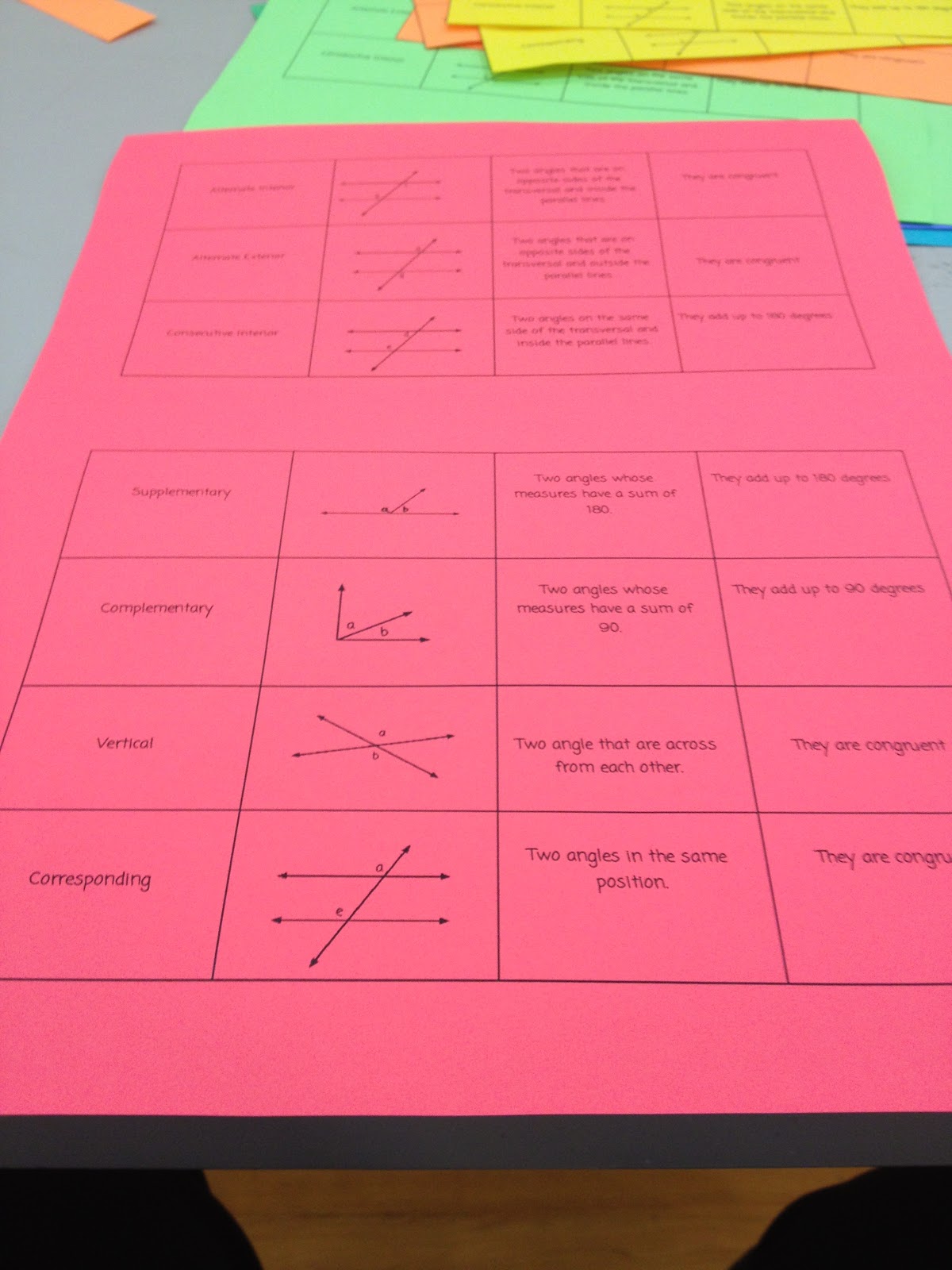
One of my favorite things to have the students do to help them memorize information is to create a sorting activity. I will have them do the sorting activity a few times through out the unit to help them remember the information.

I start off by creating a document with a table.  In this case I created an activity to help my students learn the different angle pairs in Geometry.  One box is the name, another is a picture/example, next is the definition, and the final box is the relationship.

Once I am finished typing it up, I copy it on different colored sheets of paper, cut them up and paper clip them together.  Sometimes I have them laminated so that they can be used over and over again.

The colored paper in my book is a MUST!  Often my students will drop a piece on the floor and when they are colored it's easier to know which clip they belong in.  I use to do them on white paper but would spend a lot of time trying to figure out which clip the dropped piece would belong in.


I have created problem sorts as well where one card had a math problem and the other one had the answer. These were usually like 10 problems long. It allows students to get immediate feedback to see if they are doing it correctly.  They know it was done correctly if they can find their answer, otherwise they know to go back and work it out again.

 Another sort I have made was on the scientific method.   One half of the table was the steps and the other side was a part of a lab write up that I broke down into parts.  The students had to read the part of the lab and determine which step that was. 

Sorts can be used for so many different topics...Parts of a story, Historical Events with their causes and effects, cooking equipment with their names, lab equipment with their names, etc.

If you use sorts please share your ideas!

Tuesday, October 16, 2012

Vocab Wall

Vocabulary is something that I feel is extremely important for every class a student is in, but especially when it comes to math and science.  I try very hard to stress with my students that by learning the vocabulary for each unit it will not only help them understand the content at a much deeper level but often learning the vocabulary helps teach the content.

I've always taught vocabulary words at the beginning of each unit using various strategies but felt as though after we were done they just forgot about them.  Often I would mention or bring up a word in class and get the deer in the headlights look.  After either having to remind them what the word was, or the one student out there that remembered would tell everyone else, they would say "Oh yeah, I remember" and then forget again tomorrow when I ask.

I decided that if I was going to take as much time as I was teaching the vocabulary, I would have to find a way to make them stick.  A word wall was one of the many ways I would help make those important words stick.

My word wall for Mapping Unit
The words were created in Google Drawing.  I inserted word art, typed in the word, adjusted it to fit the whole page, and then selected a cool font.  Each one was printed off, colored, cut out and pasted onto a bright colored sheets of paper.  

Each of my units are broken up into objectives and each objective has multiple learning targets.  I have vocabulary words for each of my objectives, as to not over load students with to many words at one time.  So to keep the words organized I colored the vocabulary words for each objective in different colors, blue was objective #1 and purple was objective #2, but all on the same colored paper.  

Since my vocabulary words for each unit do not change from one year to the next I had them laminated so that they could be used over and over again.  Sometimes I write on them with either a drawing or a memory hook, using a white board marker (they easily clean right off).  

The vocabulary words are now always present each day and I force my students to use them in their work or when giving an answer in class.  I have found that by just making them present every day that they use and remember them.
Related Posts Plugin for WordPress, Blogger...