Showing posts with label New Fun Ideas. Show all posts

Friday, January 27, 2017

Candy Land


So about 2 maybe 3 years ago I was trying to come up with some new ways to keep my students engaged in math class on the days where...well frankly...they just need to practice.  We all have those days and honestly, they are the days that both my students and myself dread.  It's boring for me, they get cranky, and everyone is just off task.  To them it feels like "busy work", which it's not, they need to master the skill before they can apply it, but that's how they feel.  One evening by some miracle I came up with life-sized Candy Land.   Before you get all excited there is no Mr. Mint, Princess Lolly, Lord Licorice, or Queen Frostine.  I laminated colored squares of paper that I put in the pattern on the floor.  There is a start and finish square, and the students get to pick their own game piece (I'll talk about those later!).  They draw cards out of a bucket with problems on one side, and either a single colored square or double colored squares on the other.  If the students answer the problem correctly they move ahead that many colored squares.  If they answer it wrong, they don't move at all.  The team to make it to the end wins!

Here's how it looks...


It's pretty basic but my students absolutely love to play it.  I have watched students jumping up and down to come to math class because we are playing it. When I first started the winning team would get candy bars of their choice.  After a few years of playing, I have made a few adjustments to the game.


I have added chips that can make them advance or have to go back, and if they are super lucky they get a go back to start chip.  Instead of just the winning team getting candy I decided to put chips on specific squares around the room.  The first team to land on that square after answering a problem correctly removes the chip and turns it in at the end of the hour for candy.  This way those students who might are further behind won't give up so quickly.  

The game pieces are the best part of this whole game, and the part they will race to class and fight over getting.  They are just random things I have in my classroom and many of them I have no clue where they came from.  The bucket of pieces keeps growing each year and they are getting better and better. 


The colored squares have been used by a ton of teacher in my building.  What's funny is what game pieces they come up with to use.  Our Nursing Program borrowed it and used fake organs as their pieces and it was AWESOME!  I hope to add to the game the Rainbow Trail and the Gumdrop Pass, it's what they keep asking for.  


Monday, August 17, 2015

Assigned Seating Problems and Groupings


When it comes to seating arrangements in my classroom I'm a groups/pods/tables/etc. kind of teacher.  I try to instill in my students a sense of collaboration and teamwork.  I love when they work together to solve problems and enjoy seeing students helping and supporting one another.  The only issue I find with groups is that I tend to only have the students work with those in their group.  I hate deciding who is going to work with who and I needed to find a different way to do things.

A fellow coworker of mine numbers her desks, this way when it is time to assign students to a seat she gives them a number and they find their desk rather than trying to give them directions to their desk which they inevitably never locate correctly.  So I decided to do that this year, but being the teacher that I am I had to make it different and my own (not that there was anything wrong with her method, but she's an English teacher so she didn't see the Math possibilities behind this genius idea).  

Here is what I did…

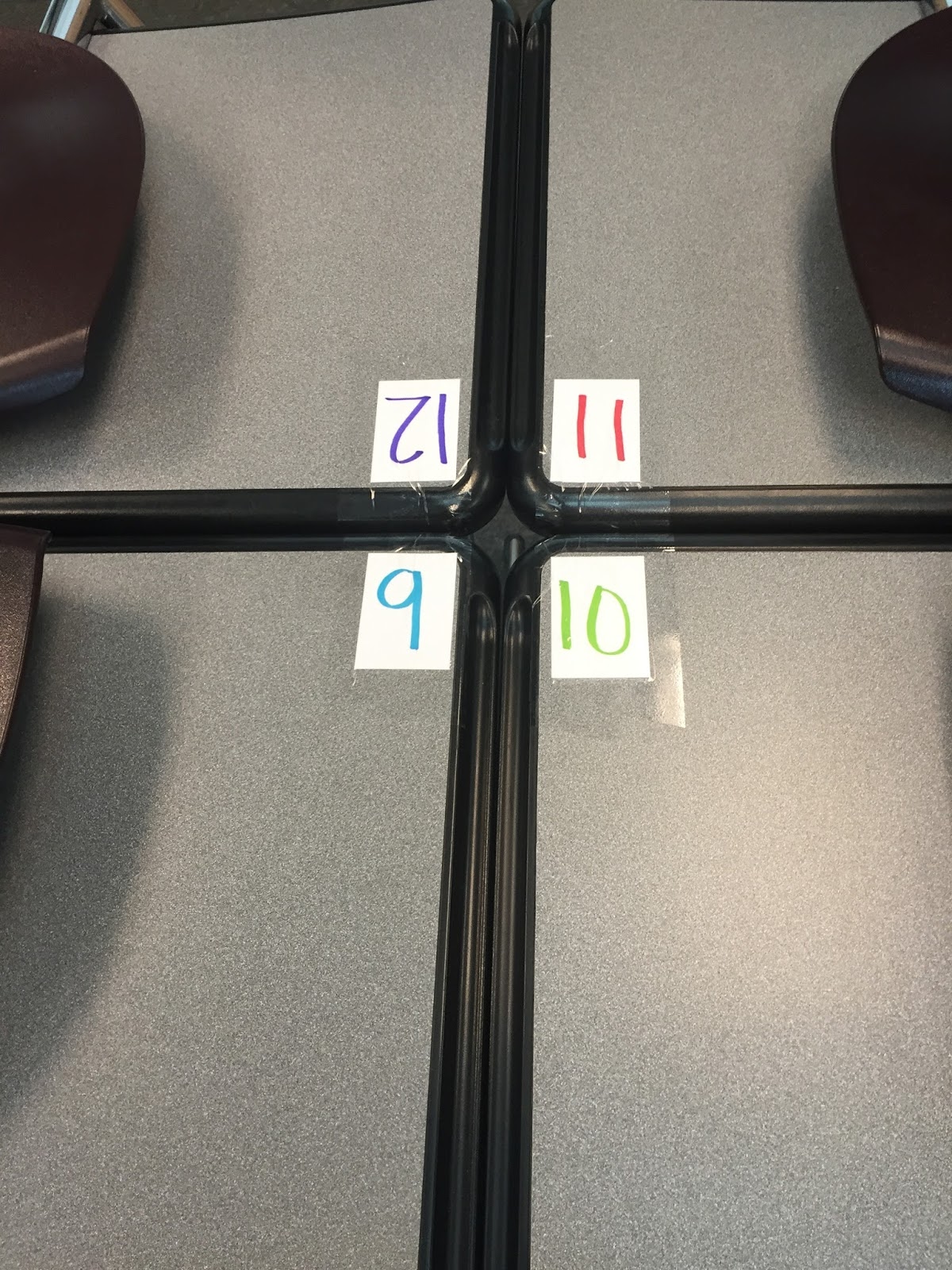
I have 24 desks in my room and I put them into 6 groups of 4 desks.  Each desk is numbered 1-24 using a blue, green, red, purple pattern (repeated for all 6 groups).  I then created a seating chart like I normally would but put their number and color in each box.  I made sure that for each of my classes I had the same number of kids sitting in each color seat.  

On the 1st day of school, I always greet the students in the hallway making sure they are in the right class and helping others find their way around.  HERE IS THE MATH BEHIND THIS GENIUS IDEA!! This year I will be giving each of my students an index card that has a math problem on it with their name.  The answer to their problem lets them know what number desk they are assigned to.  I'm excited about starting with math as soon as they walk in the door!  I differentiated the problems on the cards based on the ability level of my students (the ones I've had before) I focused on solving linear equations but for my freshmen I gave them Order of Operation problems since this is a skill I know their former teacher was working on with them.  Some of my other ideas to shake up my groups is to have them work with their same color peers, maybe do even and odds, greens with purples and reds with blues, etc.  Can't wait to see how this goes on Wednesday for our 1st day of school!

Thursday, July 24, 2014

Whiteboard Folders

The unit my students struggle with the most in Algebra is Writing Linear Equations.  Even though the concept of only needing the Slope and Y-intercept to write the equation is a pretty straight forward concept my students struggle because of all the different types of problems they come across.  They are never to sure which method they need to use.

Since all of my students are at different levels, some understand the more basic problems but struggle with the harder ones, and some are completely lost.  This is defiantly a unit I have to differentiate for my students.  So I came up with these whiteboard folders for all of the different Writing Linear Equation problems they will come across.

Supplies you'll need:
Colored Paper, Laminator, Manilla Folder, Scissors, Hot Glue Gun, Marker


How to make the folders…

1st: I hot laminated colored paper.
2nd: Cut almost all of the front cover of the folders off, leaving about 3 inches (this give the kids enough room on the laminated paper to do the work).
3rd: Hot glued the laminated colored paper to the inside of the folder.


4th: On the cut front cover I numbered and wrote out the problems, one type of problem per folder.
5th: Cut the front cover so each problem is it's own flap.


6th: On the inside of the flap write the answer to each problem.


7th: The folder tab has what type of problems they are on it.


I made folders for problems when you have the Slope and Y-Intercept, Slope and One Point, From a Graph, Two Points, Parallel Lines and Perpendicular Lines.  The students wrote on the laminated paper using a dry erase marker and wipe them clean.  These folders allowed students to practice and get immediate feedback by checking their own answers.  I've also used them where students pair up, one is the teacher the other is the student.  While one student works the problem out on a regular whiteboard the "teacher" can check the "students" answers using the folder.

Monday, June 24, 2013

Station Activities

At the end of each year I like to think about what worked and what didn't work for my students so I can improve for next year.  Since I'm the only Special Education Math and Science teacher for my building/district, I have the same kids for 3-4 years.  So reflecting back really helps because I can see the improvement in my students and myself from one year to the next.

So what I have found out about this past school year is that my students absolutely LOVE their ISN and Station Activities.  There are many things they enjoyed about this year but those are their most favorite, and are the most effective.  

Here is how I create my station activities.  At the end of each day I give my students an exit ticket, and the exit tickets are based on the current unit objectives.  Sometimes if I know my students will need to use a previously taught skills I will incorporate that into the exit tickets as well.  These formative assessments allow me to see where each of my students are at; what they know and what they don't know.  Based off of that information I create my station activities.  

For this example we were just starting to work on writing equations in slope intercept form and some of objectives were:

I can calculate the slope given a graph, table, or two points.  
I can determine the slope and y-intercept of a line given the graph of a line.
I can write an equation in slope intercept form given the slope and y-intercept.

My students were given the exit ticket after we went over the ISN pages and did some whole group practice.  When they were finished I checked them to see which problems they got right/wrong.  For this class I had students who got problems incorrect from each objective, so I created stations based on each objective.  


This time I assigned them specific stations they had to complete based on the problems they got wrong from the exit ticket.  If there was time they could go back and do the other stations for practice.  Other times I have had stations for a test review and each table had an activity based on each of the unit objectives.  When I do this they are expected to finish all of the stations.

The main reasons why I like stations is because they get the students up and moving around the room, it allows me to work with individual students, and lastly they get excited because it isn't just a boring worksheet.

**I used Expo Neon Dry Erase Markers on my black lab tables, they wipe away easily with a wet rag. If you don't have black tables you can use regular colored Expo Dry Erase Markers on tables or student desks.**  


Thursday, May 2, 2013

Angle Sum Theorem

I've taught Angle Sum Theorem in the past but I felt as though my students didn't truly understand what it means or how it actually works.  They can tell you that all angles in a triangle add up to 180 degrees, but if you ask them how do you know it's true they couldn't give you a good reason.  I usually get the response of "because you told us it does".  UGH!  Not the response I'm looking for.

This year I was determined to find a way that would help them understand just how it worked, and I came across these two different methods.  I used BOTH.

The first method is where you give students three different triangles: Equilateral, Scalene, and Isosceles.  They color each of the angles in the triangle a different color and rip off the angles.  Then they have to join all three angles, and in the end they form a straight line which they know measures 180 degrees.

The second method we used is where each student again is given three different triangles: Equilateral, Scalene, and Isosceles.  They again color each of the angles in the triangle a different color.  They start off by folding the triangle to create an altitude. Then the top angle is folded down to the point where the altitude and base meet.  The two other angles fold in, showing all three angles lined up creating a straight line.

They liked the folding method because when they glued them into their ISN they were able to fold and unfold the triangle as many times as they want.  The ones that were ripped could only be done the one time.


Here are the left pages when they are finished.  
Unfolded Triangles
Folded Triangles

On the right side of their notebook we worked out several different types of problems involving the angle sum theorem.  We also revisited supplementary angles, vertical angles, as well as the different types of triangles and their characteristics.

Overall this page so far has probably been their favorite.  I succeeded in getting them to understand why the angles in a triangle add up to 180 degrees, and I no longer get answers of "because that's what you said".

Friday, March 1, 2013

Functions Continued...

I love my students and wouldn't change them for the world, but so often they have a hard time with math that has multiple steps.

We were working on function and they needed practice, but not just sit at their desks and work on a worksheet practice.  So I decided to make these huge posters, one poster for each of the three steps for graphing a function.  

This activity got my students up and moving around the room while still working on practice.  The few feet between each step made a big difference.  It gave them time to stop thinking about what they just did and focus on what they are to do next.  To them it made each problem seem like three easy tasks.


I had three sets of these posters and even though it was only three problems worth of practice they got each of them correct.

At the end of the hour I gave them an exit ticket over these types of problems and found that most of my students were ready to move on the next day.  I did have to work with one student who has been struggling all year, but this activity gave me the time to do just that.

Sunday, November 18, 2012

Math Puzzle

Every student needs practice with the content that you teach, especially in math.  However, I think sitting there doing a typical worksheet is boring, and the students think so too.  Whenever a worksheet is passed out I can hear the sighs of disappointment in the room.

But what can you do when all they need is practice...

I created this puzzle for my students to practice solving equations with variables on one side of the equal sign.

My classes are small but I always make at least 10.


I copied them onto colored paper (it makes it easier to know which puzzle they below to when a piece gets lost), laminated them, cut them up and clipped them.


A students start to the puzzle
 Students worked the problems out on a separate sheet of paper and when they find the answer, the piece bumps up next to the equation. 

Many times the students will initiate a competition to see who can finish the puzzle correctly the fastest.  The first time seeing these they can be over whelming because students don't always know where to start.

My suggestion to all of them is pick one piece and work one problem out on that piece, it will lead you to a piece that has new equations to solve for and eventually you will create the puzzle.  If you just keep randomly picking up a piece to solve a puzzle you will end up with lots of buddies but no puzzle. (this is hard for my students to then figure out what to do)


Saturday, November 3, 2012

Interactive Student Notebooks

I first want to say that I am in no way an expert in Interactive Student Notebooks.  My group of Algebra students this year are having a hard time with math, in fact they voiced their hatred of math many times at the beginning of the school year.  After getting to the root of their hatred, I found that it's mainly because all they ever did with their previous teacher was worksheets.

I searched for many weeks to find something that would teach these students how to take notes, keep themselves organized, and most of all have fun while doing it.  Enter in Interactive Student Notebooks!


SETTING UP ISN
  • Composition Notebooks (from what I've read they are the most durable, and it's also hard to rip out pages.  I found these for 93 cents at Target)


This is mine


  • I had my students cover their notebooks in colored paper, and cover it with "Numbers Important to Me".  I have seen some notebooks where they are covered in pictures from magazine.  I like keeping it math related! When they were finished I covered the front and back in clear shipping tape, it helps keep them clean and extra durable.


  •  The first page of the ISN was a grading rubric.  I'm terrible at writing rubrics so I found one online.  You can get a copy of it here.


  • The next two pages became our table of contents.  This will include the topic we covered, what pages it's on in the notebook, and what date we created them on.  


  • The pages after your table of contents are used for notes.  Generally one side of the page (left side) is for the students.  They create fold ables or any sort of discovery activity.  The other side (right side) is for the teachers notes on the topic.  Each page should have a title (the topic) along with page numbers and dates.  
**I will try to post as many of the pages as I can that we have created**

When my students came in and saw the table with the notebooks piled up, the markers, colored paper, glue, scissors, and tape their faces lit up.  They were so excited for class to start and they had no idea what we were even going to do with it all.  To them it simply meant they weren't doing worksheets, and they were happy about that!

Wednesday, October 24, 2012

Sorting Activities

One of my favorite things to have the students do to help them memorize information is to create a sorting activity. I will have them do the sorting activity a few times through out the unit to help them remember the information.

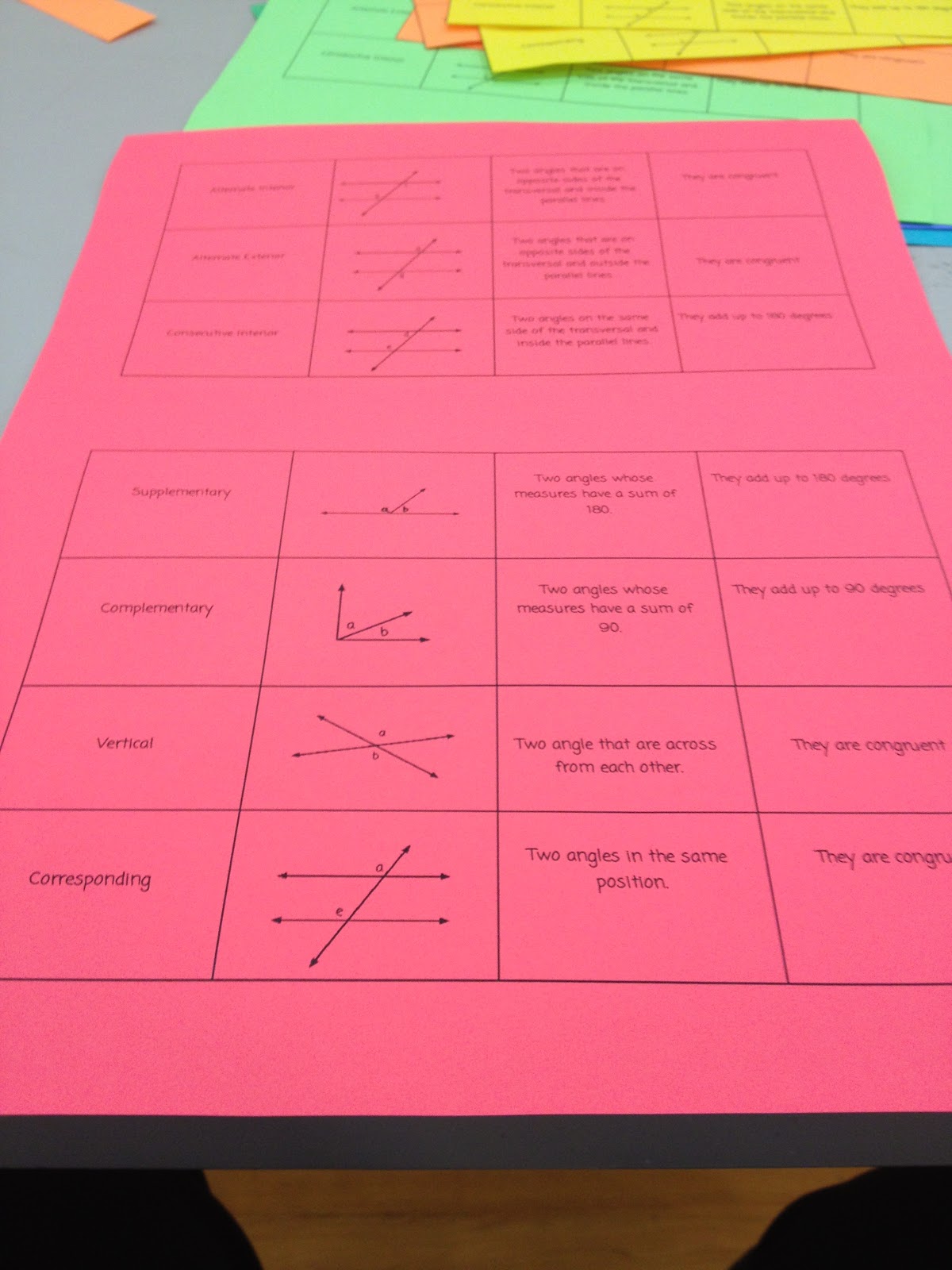
I start off by creating a document with a table.  In this case I created an activity to help my students learn the different angle pairs in Geometry.  One box is the name, another is a picture/example, next is the definition, and the final box is the relationship.

Once I am finished typing it up, I copy it on different colored sheets of paper, cut them up and paper clip them together.  Sometimes I have them laminated so that they can be used over and over again.

The colored paper in my book is a MUST!  Often my students will drop a piece on the floor and when they are colored it's easier to know which clip they belong in.  I use to do them on white paper but would spend a lot of time trying to figure out which clip the dropped piece would belong in.


I have created problem sorts as well where one card had a math problem and the other one had the answer. These were usually like 10 problems long. It allows students to get immediate feedback to see if they are doing it correctly.  They know it was done correctly if they can find their answer, otherwise they know to go back and work it out again.

 Another sort I have made was on the scientific method.   One half of the table was the steps and the other side was a part of a lab write up that I broke down into parts.  The students had to read the part of the lab and determine which step that was. 

Sorts can be used for so many different topics...Parts of a story, Historical Events with their causes and effects, cooking equipment with their names, lab equipment with their names, etc.

If you use sorts please share your ideas!

Saturday, October 20, 2012

Round Robin

I love strategies that allow the students to activity work, get immediate feedback, and give me the opportunity to help my more struggling learners.  One of the greatest strategies is the "Round Robin".

To create a round robin...

I cut in half bright colored sheets of paper, in the example below there were 21 of them all together.  On the first card you write a problem or question you want to students to answer.  On the second card you write your next question, but in the bottom right hand corner you write the answer to the question on the first card.  On your third card you write another question and in the bottom right hand corner of that you write the answer to the second problem.  When you get to your last question the answer to that one goes on the very first card you created.  In the end it makes a giant loop.  I shuffled them up, so they weren't in order, and taped them up around the room.

I did have them laminated so I can use it over and over again.  I'm all about doing something once instead of once every year!

These are all of them!

I put them in order so you could see the format.

Just some tips...

  • Don't have an answer repeat.  It will lead students on a loop that is smaller and they will not get to every problem.
  • Students can start at any problem they want, they will start and end at the same problem if it is done correctly.
  • Write large so that the students can see the answers from across the room. 

The first few times I made one of these I messed it up, so don't worry it gets easier as it goes!

Tuesday, October 2, 2012

Drawing on the Windows

So we have been in school since the middle of August and every day I'm trying to find new ways to keep my students engaged.  The other day I decided that instead of using the whiteboards or the SMART board I would use the 6 giant windows that I have in my classroom.

My Geometry class is currently working on solving for the missing angles using our awesome Algebra skills! We are focusing on complementary and supplementary angles.

I drew six different problems ranging in difficulty level as you move down the line of windows. Immediately when my students came in the door they saw the drawings on the windows...How I don't know cause they are hard to see until till you get up close.  They had a great time solving each of the problems and asked if they could draw on the windows too.  I decided to have them come up with their own problems and work them out, just to make sure they worked out in the end.  I wanted them to create problems where none of the angles were given, and where each angle contained variables.  This way they had to solve for the missing variable first and then plug it in to find the measure of each angle.

Many of them complained at first saying "This is to hard" but after a few minutes they began to make a game out of it, seeing who could come up with the hardest problem. It took many of them about 15 minutes to come up with their own, but they were excellent problems and they were proud of themselves.  So after checking each of their problems I let them draw them up on the windows. (You can see two of their examples below).

It's a little hard to see but the problem is 5x +4, x-2, and 3x +7.  Courtesy of a student.

Sorry for the store shed being in the way but this problem was 3x, 4x, and 3x.  Again courtesy of a student.


It was probably one of the best days in class that we have had in about a week and as the day went on other classes were upset that they didn't get to do math on the windows.

All that we used were Expo dry eraser markers to draw on the windows, and they easily come off with a rag.  If it gets dry, like mine did because it sat over night, a little windex takes them write off.

Related Posts Plugin for WordPress, Blogger...